Grade 7 Science Unit 1: Characteristics of Living Things
Grade 7 Science Unit 1 Characteristics of Living Things
Topic 1: Characteristics of Living Things
Biology
· The study of living things
· Includes microorganisms, plants and animals
Characteristics
· Features or traits (Ex. A long neck is a characteristic of a giraffe)
Organisms
· Scientific term for a living thing
Species
· A specific type of living thing that has similar characteristics
· The organisms must be able to reproduce and produce young that can also reproduce (Ex. humans, cats)
Characteristics of Living Things
· All organisms grow.
· All organisms move.
· All organisms reproduce.
· All organisms produce or consume (eat) food.
· All organisms respond to stimuli in their environment.
· All organisms exchange gases.
All Living Things are made of:
· Cells
· Have a special chemical make-up. (Carbon, nitrogen, hydrogen and oxygen)
The only characteristics shared by both living and dead things are:
· They are made of cells.
· They are made of special chemicals.
Reproduction
· The process of making a new generation.
Photosynthesis
· The process where green plants are able to use the Sun's energy to make food.
Stimulus
· Something that causes an organism to respond
Cells
· Building blocks upon which all living things are made.
Living Things
· Organisms that shows signs of life, such as moving growing, reproducing, etc. (Ex. A maple tree)
Dead Things
· Organisms that once showed signs of life but do not any longer (Ex. Leaf fallen from a tree)
Non-Living Things
· Objects that are not alive or ever will be (Ex. Metal desk)
Plants
· Organisms that are able to make their own food by the process of photosynthesis
Animals
· Organisms that must rely on other organisms for food
| Differences between Plants and Animals | |
| Plants | Animals |
| Able to make their own food | Rely on others for food |
| Contain chlorophyll | Do not contain chlorophyll |
| Have limited movement | Able to move from place to place (locomotion) |
| Contain a cell wall | Have no cell walls |
| Cells look brick-like | Cells are round |
Topic 2: A Close Look at Growth and Reproduction
Growth
· The characteristic of life that allows all organisms to get bigger, change and repair themselves.
Life Cycle
· The stage of development that an organism goes through in its life.
· Includes the process of reproduction, the pattern of growth and its adult life.
Different organisms have different patterns of development with lots of variation
Growth spurts in humans
· Boys between age 14 - 16
·Girls between ages 11-13
Animals that grow in starts and stops such as animals with exoskeletons.
· Skeletons surround their body (outside)
· Ex. Lobster, crayfish and insects
·When these organisms grow they "shed" their shell. They then grow a larger one.
· Growth occurs in a series of spurts, between the shedding of the old skeleton and the hardening of the new one.
Growth for Repair
· All organisms can repair their muscle, skin and bones.
Regeneration
· The process by which an organism grows new tissue or body parts to replace those that have been destroyed.
| Animals | |
| Invertebrates | Vertebrates |
| Animals without backbones | Animals with backbones |
| Can grow back lost parts (Ex. Legs, claws, tails) | Limited ability to regenerate lost parts |
| Ex. Starfish, planaria, earthworm, lobster, crab, crayfish | Ex. Salamanders can regenerate a lost tail |
Reproduction
·The replacement of an old generation by a new generation.
·The process of producing a new generation.
| Two Types of Reproduction | |
| Asexual | Sexual |
| 1. Amoeba (splitting in two) | 1. Humans |
| 2. Strawberry plants (runners) | 2. Animals |
| 3. Potatoes (eyes) | 3. Plants (with both male and female parts) |
Topic 4: A Close Look at Movement (pp. 34-45)
Locomotion
· Locomotion - The process of moving from place to place.
Types of Locomotion
1. Animals with legs and skeletons (Ex. Humans/grasshoppers)
· Skeletons - provide support
· Muscles - Attach to the bones they contract (shorten) creating a push or pull of the legs.
· Ex. Humans (Skeleton inside the body) or Grasshopper (Skeleton outside the body-exoskeleton)
2. Animals with No Legs
· Skeleton - provides support, bendable
· Muscles - expand and contract
· Ex. Snake - It slithers along the ground in S-shaped curves, pushing off rocks, grass, etc.
3. Animals with No Legs and No Skeleton
· Flexible bodies - divided into segments
· Segments - contain 4 pairs of bristles (giving grip)
·Two types of muscles - allow the work to make itself longer and shorter (together with the bristles allowing it to move forward)
· Ex. Earthworm
4. Movement in Water
·Move through the water by curving their bodies and wriggling back and forth
· Fins and tail help it move forward and in other directions.
· Ex. Fish, shark
Movement
· Movement - A change in an organisms shape or position (limited)
Internal Movement
·Movement inside the body (Ex. blood flow)
Vital signs
· Signs that show the body are functioning properly.
·Types: Body temperature, blood pressure, pulse and breathing rate
Movement in Plants
· Movement in plants is "less obvious" than movement in animals
Examples
1.Shoots
·Hedge plants send out shoot
· The plant spreads across the ground
2.Bending toward light
· Plants grow toward the Sun;more favorable conditions
3.Sensitivity
· Mimosa will lose water and sags when touched
· Venus flytrap closes its leaves when touched
Topic 5: Sensing and Responding to the Environment (pp. 46-51)
Stimulus
· Anything that causes an organism to react
·Ex. Bright light causes the pupils of the eye to dilate.
Response
· To react to a stimulus
Sense Organs
· Specific parts that detect stimuli and respond to it
· Ex. Eyes, ears, nose, skin, tongue
Reaction time
·The speed in which an organism responds.
Receptor
·A group of cells in a sense organ that receives a message from the outside world
· The body part that receives the stimuli.


Examples of Stimuli and Responses
1. A plant grows toward the light
· Stimulus - light
· Response - Movement (growth) toward the light
2. The teacher yells, the student moves away
· Stimulus - Yelling
· Response - Movement away
Positive response
· Movement towards the stimulus
Negative Response
· Movement away from the stimulus
Handling the Microscope (pp. 368-372)
Two Types of Microscope
1. Simple
· Contains one lens
2. Compound
· Contains two or more lenses
How to Handle a Microscope
· Use two (2) hands to carry; one on the base & one on the arm
·Place on a clean/level surface. Away from the edge.
· Check the plug before you start.
· Keep clean.
·Begin to focus using low power first.
·Cover after use.

Wet mount
· A glass slide that uses water and a cover slip.
· Prepared to use under the microscope.
Stain
· A chemical that is used to make parts stand out.
How to Prepare a Wet Mount Slide
1. Start with a clean slide.
2. Add a drop of water.
3. Place a sample in water.
4. Cover the slide with a slip; drop it at an angle of 45 degrees to avoid air bubbles.
5. View under a microscope.
How to Use a Microscope
1. Place a slide on the stage.
2. Start at LOW power; use fine & coarse adjustment.
3. Move to medium power; use only FINE adjustment knob.
4. Move to high power; use only FINE adjustment knob.
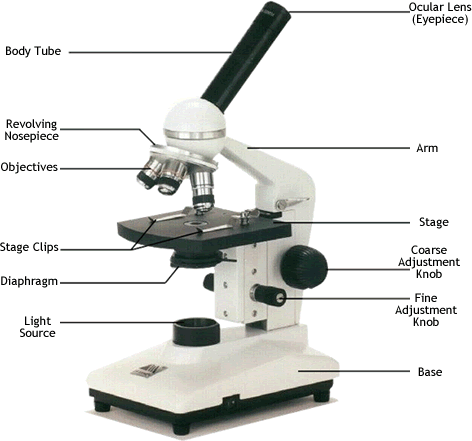
Parts of a Microscope and their Function
| Part | Function |
| Eyepiece | Eye views object under observation |
| Coarse adjustment focusing knob | Dial used to make the object clearer in the eyepiece |
| Fine adjustment focusing knob | Similar to the coarse adjustment focusing knob but for greater clarification |
| Stage | Flat surface o the microscope used to mount slides upon |
| Base | Used to support the microscope on flat surface |
| Arm | Used to support the eyepiece, body tube and lens above the stage. |
| Lamp | Light source to improve viewing of slides |
| Diaphragm | Used to pinpoint light source on the slide |
Cells
· The tiny, living building block, which makes up all living things.
| Animal and Plant Cells | |
| Similarities | Differences |
| Both plant and animal cells contain a nucleus, vacuoles, plasma membranes | Plant cells contain chloroplast Plant cells have larger food vacuoles Plant cells have cell walls Plant cells are rectangular; animal cells are round or oval |
| Cell Parts and their Functions | |
| Part | Function |
| Nucleus | Control center of the cell (brain) |
| Vacuole | Stores the food |
| Cytoplasm | Jelly-like material (mostly water) |
| Plasma membrane | Allows material in and out of the cell |
| Chloroplast | Makes the food |
| Cell wall | Provides structure and support for the cell |
Animal Cell Diagram

Plant Cell Diagram

posted by C. Fowler @ 9:47 AM
0 comments